Sometimes the book you’re reading is the medicine you need. It can be a comfort, a hug, a jolt. Kiran Desai’s The Loneliness of Sonia and Sunny was that book for me during a three-week bout of acute sinusitis. It’s 671 pages, and tells the fraught love story of Sonia and Sunny. Their families back in Delhi set them up.
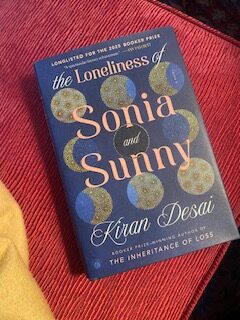 Sonia is in New York, post college, working at a gallery, involved with a world-class artist who’s a sadist. (Those sections are hard to read.) Sunny is in New York, too, working as journalist and living with Ulla, a white girl from the Midwest, whom he hides from Babita, his widowed mother.
Intertwined is the sad but understandable story of Sonia’s separated parents, the death of Sonia’s father, the slaughter of Sunny’s uncles, a new life for Babita in Goa.
Highly recommend.
I confess to a few days of “book grief” after finishing The Loneliness… I read magazines and newspapers, eyed my stacks. Finally I picked up Mrs. Sartoris, a slim read (143 pages) by Elke Schmitter, translated by Carol Brown Janeway.
This got me out of my funk!
 The setting is post-war, pre-Internet Germany. Margarethe, the title character, is a spoiled and beautiful young woman spurned by the first love of her life. In a fit of revenge, she marries the dependable Ernst, who has a lame leg and a widowed mother who does all the cooking, housekeeping and childcare.
Margarethe throws off this steadiness for an affair with a married arts administrator. I winced reading the passages that detailed her early morning wait for him, after she proposes they run off. Yes, this book shares fingerprints with Anna Karenina and Madame Bovary — with a twist. I couldn’t help cheering when the mother tiger emerges in Margarethe.
As my friend Jennifer says, a short book is the best gift for some readers.
After The Loneliness… did not win this year’s Booker Prize, I sought out some of the other finalists. Andrew Miller’s The Land In Winter is a beautifully told story of two young couples in the English countryside during the winter of 1963, during a crippling blizzard.
 Eric is a physician who makes house calls in his spiffy Citroen; his sophisticated wife Irene is pregnant and bored at home. Across the way is a farm, tended by newbie Bill and wife Irene, also pregnant and plagued by voices.
Irene finds proof of Eric’s affair with a local woman and sets off on foot in the storm. Eric’s car is destroyed, with a baseball bat, by the woman’s husband and son. (The writing is so good I flinched with every strike.) Bill leaves, too, for London, to get the money he needs to expand his farm operations.
The author Scott Turow says that a good ending restores a fractured world to its beginning, the same but changed. This book’s ending does just that.
A lovely read.
Happy Thanksgiving! 